
Why WhatsApp Is Risky for Business Communication (Even If Banks Use It)
WhatsApp is convenient. But for business, convenience is not security. Many business owners use WhatsApp for pricing, approvals, passwords, and confidential negotiations—and that’s where problems start.
Banks use WhatsApp too—so what’s the difference?
Yes, many banks use WhatsApp, but mostly as a controlled service channel (verified account + automated workflows). In many cases, the OTP is still delivered by SMS and simply entered in WhatsApp as an interface. Banks treat WhatsApp like a front desk, not a vault.
Why WhatsApp is risky for sensitive business chats
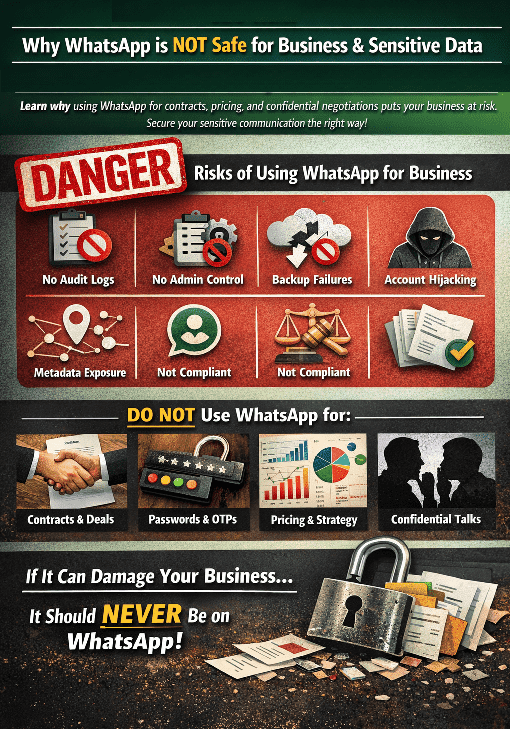
- No audit logs: No proper trail of who accessed, forwarded, or deleted critical messages.
- No admin control: Employees leaving the company may still retain chat history and files.
- Backup failures: Backups are user-dependent and can fail silently—leading to permanent data loss.
- Account hijacking risk: SIM-swap, phishing, QR scams—one incident can damage customer trust fast.
- Metadata exposure: Even if messages are encrypted, usage patterns can reveal business relationships.
- Compliance gap: Not designed for regulated record-keeping, retention, or legal-grade archiving.
Smart rule for business owners
Use WhatsApp only for basic coordination (appointments, updates). For anything confidential—contracts, pricing strategy, passwords, legal matters—use official email, secure portals, or business tools with admin control and audit logs.
Final word: If it can damage your business when leaked, it should never be on WhatsApp.
